
Pharmacy services
Pharmacy services are additional fee-based services with the purpose of supporting safe use of medicines, wellbeing and health. Get familiar with the services and search for pharmacies that offer them through the Pharmacy search.
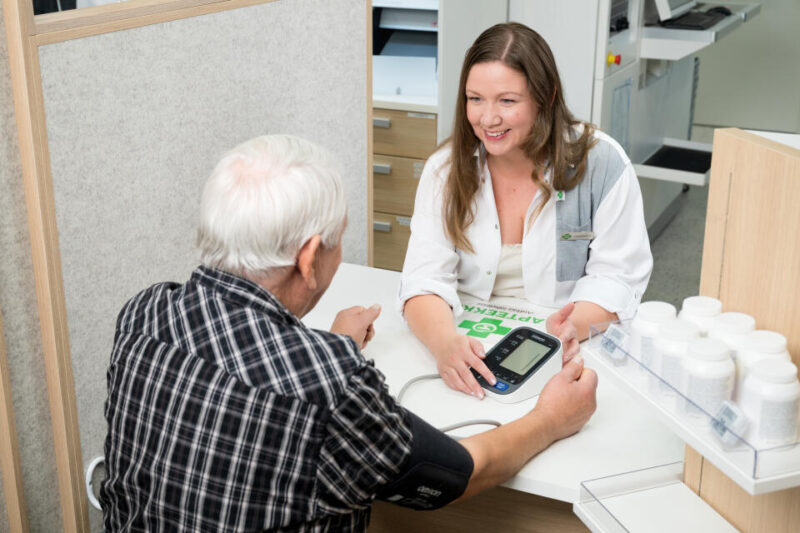
Table of contents
Pharmacy health services
Pharmacy health services provide an easy and safe way to look after of your health. The most common services include vaccinations, the administration of prescribed injectable medicines, ear irrigation, point-of-care testing and health monitoring.
The provision of services is subject to healthcare authorisation. Pharmacy health services may be provided by pharmacists and nurses, and the range of services varies between pharmacies.
Vaccinations
Vaccinations are an effective and safe way to prevent infectious diseases and their complications. Vaccination is a natural and safer way to acquire protection against a disease than contracting the disease.
At pharmacies, vaccinnation services are available against common infectious diseases, including influenza, tick-borne encephalitis, pneumococcal diseases, shingles, and many travel-related diseases.
Vaccinations are administered by trained healthcare professionals. The pharmasict-delivered vaccines are available for adults over 18 years of age. A nurse may administer vaccinations to a wider group of patients. After vaccination, it is recommended to wait at the pharmacy for approximately 15 minutes in case of an allergic reaction.
Administration of injectable medicines
Some conditions require treatment with medicines that are administered as an injection by a healthcare professional, either subcutaneously or intramuscularly, at regular intervals. The administration of injections requires that the medicine has been prescribed by a doctor.
In pharmacy health services, the injections can be administered during the same visit when the medicine is dispensed at the pharmacy.
Ear irrigation
Earwax protects the ear canal, but its accumulation may block the ear canal. This may cause a feeling of blockage in the ear, reduced hearing or ringing in the ear. In some cases, the blockage may also cause dizziness.
In ear irrigation, the ear canal is rinsed with water using a syringe, allowing excess earwax to be removed. The procedure is a safe and effective way to remove earwax.
Before ear irrigation, it is recommended to use an earwax softening product available at pharmacies.
Point-of-care testing and health monitoring
To monitor health and the effects of medication, a various measurements are available such as measurements of blood pressure, blood glucose, cholesterol, haemoglobin or vitamin levels.
Measurements can be performed as point-of-care tests, in which case the result is obtained quickly on site from a finger-prick blood sample. In some cases, the sample is taken as a venous blood sample and analysed in a laboratory. The range of available measurements varies between pharmacies.
In pharmacy health services, measurements do not require a referral. Clear feedback is provided on the results, and, if necessary, the patient is referred for further assessment to other healthcare services.
Dose dispensing aid
The dose dispensing service is suitable for people who use several medicines or who take medicines several times a day.
A customer using the pharmacy-provided dose dispensing aid service receives their medicines packed into unit-dose bags for two weeks at a time. The service also includes a medication review. Dose dispensing aid reduces medicine waste and often also lowers medicine costs.
Inhaler support service
An inhaler support service ensures that a patient with asthma uses inhaled medicine correctly and knows how to take care of oral health in connection with the use of the medicine. This helps reduce medicine-related adverse effects and ensures that the medicine is more effective.
For the service provided by appointment, the patient brings all inhaled medicines in use and any spacer. During the service, the customer is asked to demonstrate how the medicine is inhaled. A pharmacist checks the inhalation technique step by step and provides guidance on the correct use of the medicine. The service also provides useful information on oral care as well as on the maintenance, storage and signs of depletion of the device.
An inhaler support service ensures the effectiveness of use of medicines, supports disease management and helps ensure the correct use and cleaning of devices. The service reduces costs by decreasing medicine waste and may reduce adverse effects affecting the mouth, such as dental caries and fungal infections.
Medication review
In the medication review, the patient’s overall medication is assessed, and inappropriate duplication and incompatibilities are identified. The correct timing of medicine administration is ensured in relation to meals, time of day and other medicines, and the suitability of medicines for the elderly is also considered.
The service includes a consultation where the appropriate implementation of use of medicines is discussed. The patient has the opportunity to ask questions and discuss medicines and any related problems or concerns in a calm environment. A written summary of the review is provided, which makes the advice received easy to remember. The summary can also be shown to a doctor if necessary.
Comprehensive medication review
In a comprehensive medication review, the possible connection between health-related problems and the patient’s current medication is assessed. A pharmacist conducts a thorough evaluation of the overall medication and prepares a report for a doctor to support potential changes to the medication.
The service includes an interview and guidance on the use of medicines.
A written summary and recommendations for a doctor are provided based on the review. A doctor makes the decisions on any changes.
The review may be initiated by the doctor responsible for the treatment, the person using the medicines, or their representative. The service always includes an interview in which all medicines in use are reviewed. This includes regularly used medicines, medicines taken as needed, non-prescription medicines, herbal products and dietary supplements, as well as dietary habits.